Description
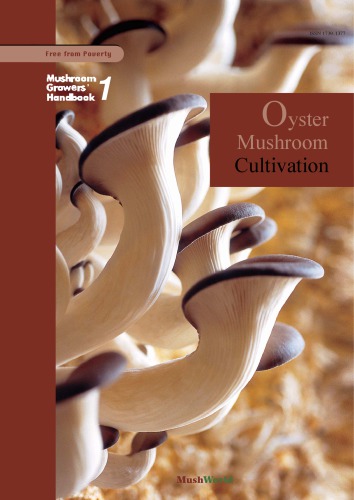
Mushroom Growers’ Handbook is published to provide more accessible information on mushroom cultivation
for people in developing countries. It will be distributed to growers, scientists, extension workers and
governmental officials in developing countries free of charge. Following Oyster Mushroom Cultivation, the topic
of this first book, cultivation of other mushrooms will be explored one by one in the following books to be
published each year. This Mushroom Growers’ Handbook hopes to reach more mushroom growers in developing countries and offer practical guides to mushroom cultivation for poverty alleviation.
Mushroom Growers’ Handbook 1: Oyster Mushroom Cultivation is consisted of four parts and twelve chapters.
Part I provides overall information on mushroom and its cultivation.
Chapter 1 is an introduction to mushroom cultivation. Brief explanation on mushroom and principles of
mushroom cultivation are provided. Why mushroom growing is a good way for poverty alleviation is discussed
with specific examples.
Chapter 2 illustrates mushroom growing and project for a living in Nepal, Zimbabwe, India, Thailand and
Swaziland.
Part II focuses on various aspects of oyster mushroom cultivation.
Chapter 3 is an introduction to oyster mushroom cultivation. It presents principles of oyster
mushroom growing and illustrated guides to oyster mushroom bag and shelf cultivation.
Chapter 4 is about spawn, one of the key elements for high yields. The chapter begins with descriptions of
commercially important Pleurotus species, followed by grain spawn making in a simply-made clean bench.
Chapter 5 is about another crucial factor- substrate. The chapter lists possible substrate materials for oyster
mushroom based on worldwide survey and presents nine examples of substrate materials: cereal straw, coco
lumber sawdust, sunflower seed hulls, grass, cottonseed hulls, sugarcane bagasse, rubber tree sawdust, groundnut
shells, and non-pasteurized wheat straw.
Chapter 6 reviews the major three factors that should be considered when a farmer builds a mushroom growing
house: site selection, construction materials and functions. Various examples of growing house from many
countries are provided ranging from simple shade to structural insulated panel house with automatic control.
Chapter 7 introduces different growing methods: log, bag, shelf and bottle cultivation with images of each step.
Readers are expected to select appropriate cultivation method for themselves and adopt tips and know-hows from
each method.
Chapter 8 is on pest and disease management. Pathogens, symptoms and control measures of each disease are
well summarized. Pests and abnormalities are also well described with informative supporting images.
Chapter 9, the last chapter of this part, covers post-harvest management. Various ways of recycling of spent
oyster mushroom substrate is illustrated. Effective ways to extend shelf life of mushroom are introduced with
detailed images.
Part III offers case studies on mushroom growing worldwide.
Chapter 10 provides in-depth researches on mushroom industry of three African countries: Kenya, Zimbabwe and
Uganda.
Chapter 11 introduces other mushrooms that can be grown in the Tropics. Detailed information on low-cost
cultivation methods are illustrated about Ganoderma mushroom, shiitake, paddy straw mushroom, and Pleurotus
tuberregium.
Part IV lists useful information sources.
Chapter 12 lists recommended books and websites on mushroom for further reading.